Keep ahead of the pack
Join our mailing list and be the first to hear our latest news and biggest announcements.
By signing up you agree to our privacy policy. You can unsubscribe at any time.
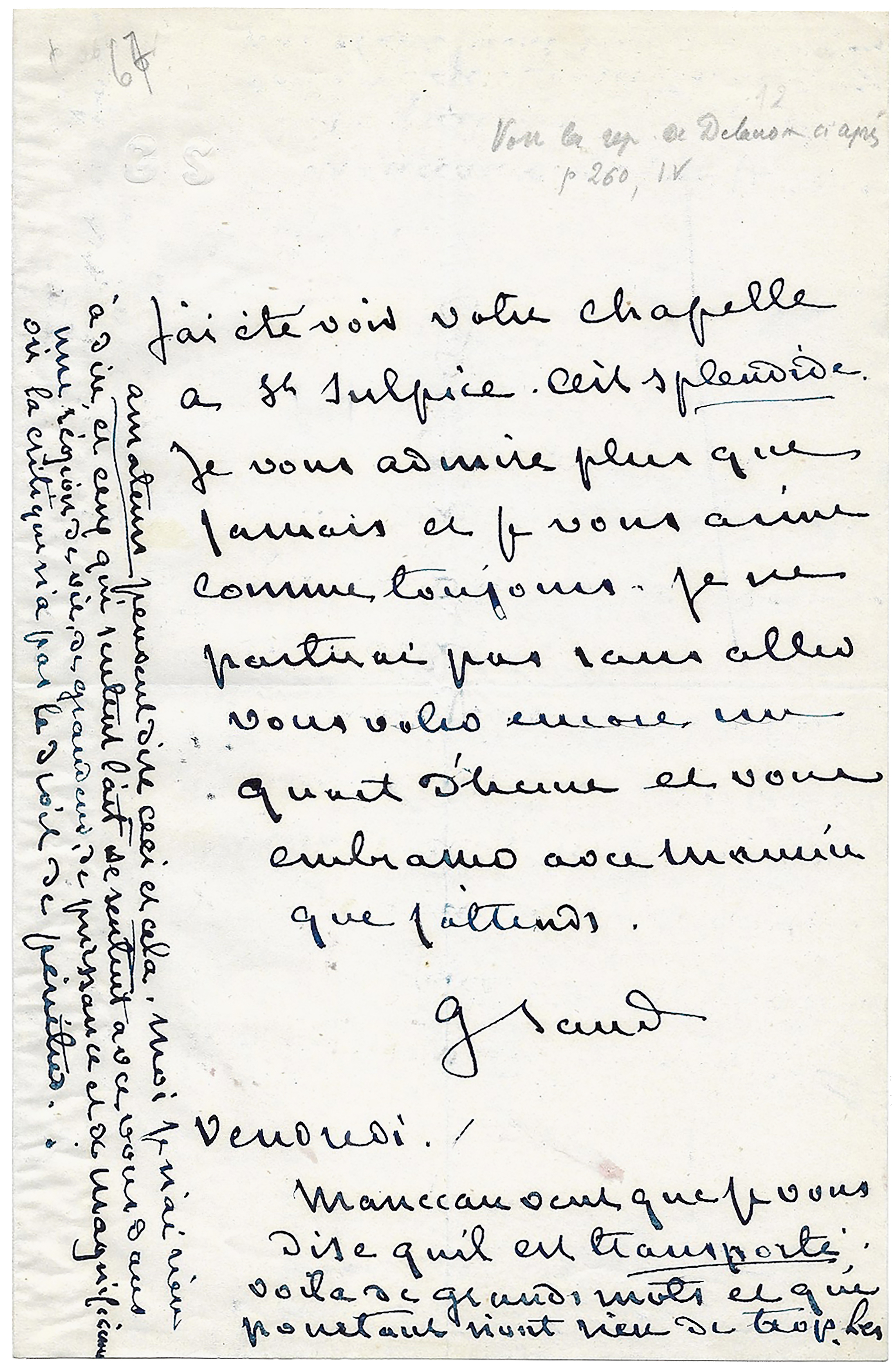
Autograph letter signed « G. Sand » to Eugène Delacroix
N.p.n.d., [Paris, 4 Apr. 1862], 1 p. in-8° on bifolium, in blue ink
« I went to see your chapel at Saint-Sulpice. It is splendid. I admire you more than ever and I love you as always »
Autograph letter signed « G. Sand » to Eugène Delacroix
N.p.n.d., [Paris, 4 Apr. 1862], 1 p. in-8° on bifolium embossed with her initials, in blue ink
Old tab mark on the fourth page, annotations in pencil by another hand
A wonderful declaration to her friend Delacroix concerning his work at the church of Saint-Sulpice, standing as the painter’s spiritual testament
« J’ai été voir votre chapelle à S[ain]t Sulpice. C’est splendide. Je vous admire plus que jamais et je vous aime comme toujours. Je ne partirai pas sans aller vous voler encore un quart d’heure et vous embrasser avec Maurice que j’attends.
G. Sand
Manceau [dernier amant de Sand] veut que je vous dise qu’il est transporté. Voilà de grands mots et qui pourtant n’ont rien de trop. Les amateurs peuvent dire ceci et cela, moi je n’ai rien à dire et ceux qui sentent l’art se sentent avec vous dans une région de vie, de grandeur, de puissance et de magnificence où la critique n’a pas le droit de pénétrer. »
In 1849, Delacroix received the commission for three murals intended for the Chapel of the Holy Angels in the church of Saint-Sulpice in Paris, an undertaking he would bring to completion in 1861. These works — Jacob Wrestling with the Angel and Heliodorus Driven from the Temple, together with the ceiling composition Saint Michael Slaying the Dragon — are generally regarded as the painter’s spiritual testament. To carry them out, Delacroix left his studio on the Rue Notre-Dame-de-Lorette, deemed too far away, and moved to 6 Rue de Furstemberg. In poor health, he was worn down by working in the cold under difficult conditions. No official was present at the inauguration of the murals. George Sand is known to have visited twice, on 26 and 9 April 1862, during her spring stay in Paris. In the Revue fantaisiste of 15 September 1861 [L’Art romantique, Lévy frères, 1868], Baudelaire devoted a highly laudatory article to the decoration of this chapel (Œuvres complètes II, ed. Claude Pichois, Pléiade, 1976, pp. 729-731).
The painter’s warm reply to his friend is well known: “I thank you for the kind impulse that led you to tell me what you thought of this great labor which occupied me so much. […] With this heartfelt thanks which I extend to M. Manceau for his flattering hyperbole […] I have no more room than to tell you that I will always love you.” (Correspondance, vol. IV, ed. André Joubin, Plon, 1935, p. 260).
This letter is one of the last expressions of affection addressed to her friend Delacroix, a friendship whose roots go back thirty years, to when the painter made his portrait of the novelist, who had at that time cut her hair very short following her breakup with Musset.
Delacroix died the following year, on 13 August 1863.
Provenance:
Marc Loliée collection, then private collection
Bibliography:
Correspondance, t. XVII, éd. G. Lubin, Garnier, 1983, n°9483
Join our mailing list and be the first to hear our latest news and biggest announcements.
By signing up you agree to our privacy policy. You can unsubscribe at any time.