Keep ahead of the pack
Join our mailing list and be the first to hear our latest news and biggest announcements.
By signing up you agree to our privacy policy. You can unsubscribe at any time.
Autograph letter signed « Romain Rolland » to Victor Margueritte
Villeneuve (Vaud) [Switzerland], 10 Oct. 1933, 3 p. in-8°
« Hitler must fall. He must, for the sake of world peace itself. »
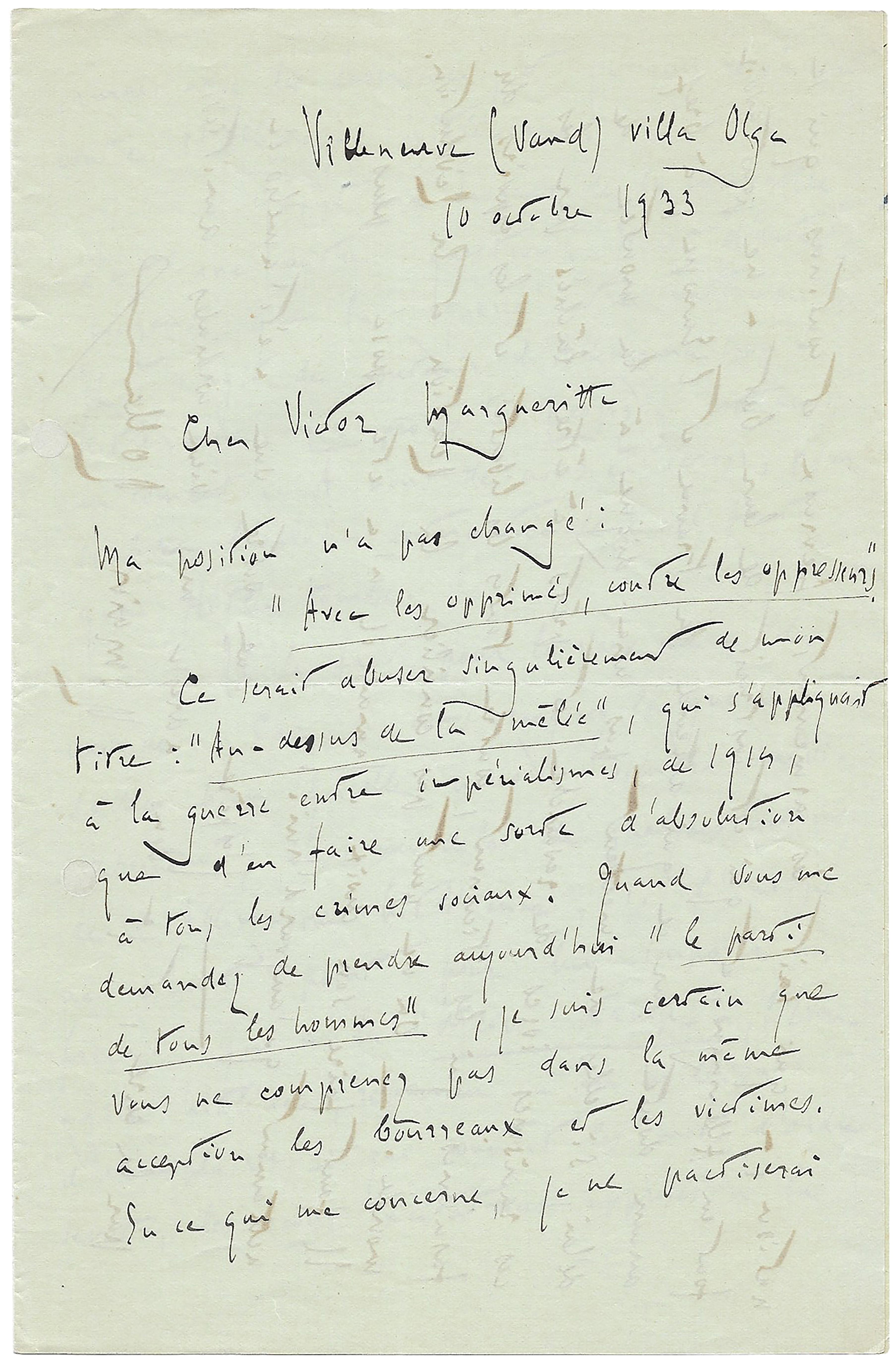
Autograph letter signed « Romain Rolland » to Victor Margueritte
Villeneuve (Vaud) [Switzerland], 10 Oct. 1933, 3 p. in-8°
In fine condition apart from four old binder-holes skilfully repaired (loss to two letters)
Prophetic letter by the pacifist writer on the expansionist ambitions of Hitler’s Germany:
« Whoever has read Mein Kampf, the Hitlerian Gospel, distributed in a million copies […] can have no doubt as to what awaits France and Europe »
One of the most important letters in Romain Rolland’s correspondence
« Cher Victor Margueritte,
Ma position n’a pas changé :
‘Avec les opprimés, contre les oppresseurs’
Ce serait abuser singulièrement de mon titre : ‘Au-dessus de la mêlée’ [paru en 1915], qui s’appliquait à la guerre entre impérialismes, de 1914, que d’en faire une sorte d’absolution à tous les crimes sociaux. Quand vous me demandez de prendre aujourd’hui ‘Le parti de tous les hommes’, je suis certain que vous ne comprenez pas dans la même acception les bourreaux et les victimes. En ce qui me concerne, je ne pactiserai jamais avec les fascismes, et je suis résolument contre l’Allemagne hitlérienne !
Quant aux moyens de la combattre, c’est une autre question. Il est d’autres moyens que la guerre entre les nations. Il s’agit de soutenir l’Allemagne non-hitlérienne. Le procès de Leipzig est aussi un combat. À nous de nous en servir, pour soulever l’opinion internationale ! Il faut que Hitler tombe.
Il le faut, pour la paix même du monde. Car si vous craignez la guerre, sachez qu’elle nous viendra inévitablement, dans un délai de quelques années, de l’Allemagne hitlérienne, si l’Europe ne s’unit point pour lui imposer un frein. Qui a lu ‘Mein Kampf’, l’Évangile hitlérien, répandu à un million d’exemplaires, – qui connaît les mots d’ordre secrets, les leçons excitatrices apprises à la nation, – qui sait les armements fiévreux et continus qui se font en Allemagne, et qui est instruit de leur but, – ne peut avoir aucun doute sur ce qui attend la France et l’Europe, à bref délai, si elle ne mettent pas une digue à la montée de ces racismes ivres de revanche et prêts à être lâchés par les fascismes qui les tiennent, contre toutes les libertés et les espoirs du monde. – On ne peut pas concilier la Réaction et la Révolution. Il faut faire son choix. Jamais il n’a été posé plus nettement qu’aujourd’hui. […] je vous adresse mes cordiales amitiés
Romain Rolland »
The clairvoyance displayed here by the pacifist writer regarding the rise of Hitlerian fascism takes on a particular resonance in the light of posterity, so accurately did Romain Rolland anticipate, in an almost prophetic manner, what was to become of Europe at the turn of the 1940s. Winner of the Nobel Prize in Literature in 1915, Rolland brought his moral authority to bear immediately after the Reichstag fire (27–28 February 1933), with his famous appeal published on 15 March 1933 in the journal Europe (no. 123). Rolland is here alluding to the fire, a major turning point in the National Socialist Party’s seizure of power, following which the Leipzig trial had just opened on 21 September 1933. Attributed by the Nazi authorities to a vast communist conspiracy, this act of arson was materially imputed to Marinus van der Lubbe, a young Dutch communist militant, and occurred during the electoral campaign preceding the legislative elections of 5 March 1933. The Nazis immediately exploited the event to justify a policy of massive repression against communists and all opponents of the regime. Shortly before Rolland’s appeal of 15 March 1933, the Nazi party had won nearly 17 million votes in the Reichstag elections of 5 March, with 43.9% of the vote. Hitler was to form a majority with the German National People’s Party (Deutschnationale Volkspartei, DNVP), which had obtained 7.97% of the vote, in order to secure, as early as 24 March, the passage of the Enabling Act (Ermächtigungsgesetz), the legal foundation of the Nazi dictatorship.
This warning from Romain Rolland to Victor Margueritte in fact reflects the former’s mistrust of the vacillations of integral pacifists, and of his correspondent in particular. Indeed, Margueritte’s pacifism was, to say the least, ambiguous: substantial sums were invested by the German authorities and various bodies linked to the Reich’s policy of influence in certain of Victor Margueritte’s pacifist journals, in order to support their circulation and ensure their propaganda. Margueritte would go on to collaborate with Germany during the Occupation, in the name of peace. He was to sign, to this effect, a letter published in 1941 in L’Œuvre, the newspaper run by the collaborationist Marcel Déat. Numerous payments arising from the mass purchase of Victor Margueritte’s works were found after the war in the archives of the German Ministry of Foreign Affairs.
Provenance:
Piasa, 22 March 2006, n°220
Bibliography:
Cahiers Romain Rolland, n°17, Albin Michel, p. 328-329
Join our mailing list and be the first to hear our latest news and biggest announcements.
By signing up you agree to our privacy policy. You can unsubscribe at any time.