Keep ahead of the pack
Join our mailing list and be the first to hear our latest news and biggest announcements.
By signing up you agree to our privacy policy. You can unsubscribe at any time.
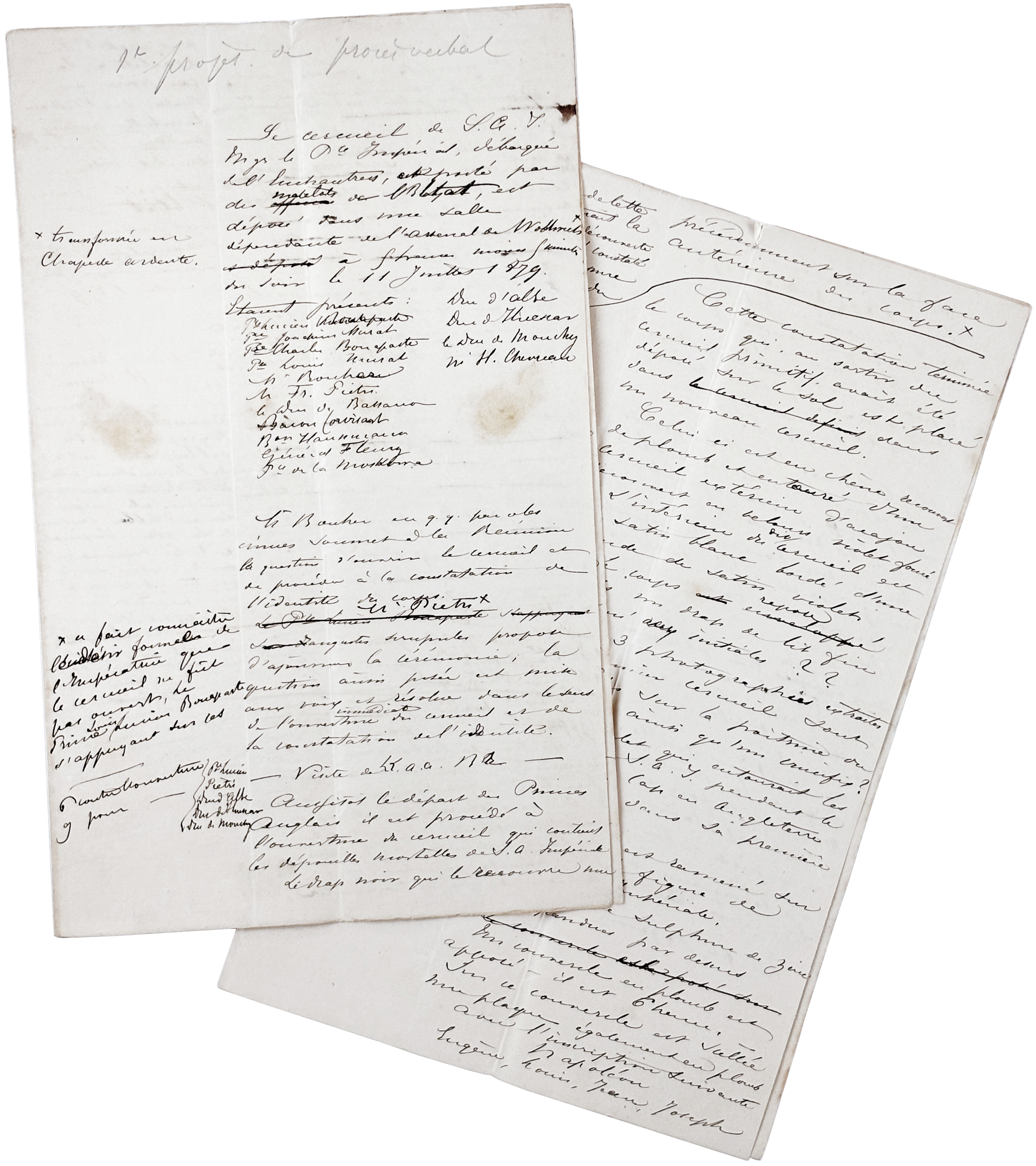
Autograph manuscript
Royal Arsenal, Woolwich, 11 July 1879, 6 pp., folio
« Of the wounds received by His Imperial Highness on the fatal day of 1 June, the traces of which were visible to all those present »
Autograph manuscript
Royal Arsenal, Woolwich, 11 July 1879, 6 pp., folio, in black ink
Watermark: “Stowford Mills 1877”
Minor stains of no consequence, slight splits along the folds of the upper margins
Manuscript in the hand of Théroulde, former head of the Grand Chamberlain’s private office; with numerous autograph marginal additions by the Marquis Napoléon de Bassano (son of the Duke of Bassano, Grand Chamberlain to the Emperor)
Numerous deletions and overwritings in Théroulde’s hand
First draft of the official report on the opening of the Prince Imperial’s coffin
A key document closing the biographical record of the only son of Napoleon III and Eugénie, killed at the age of 23 by the Zulus in southern Africa, struck by seventeen assegai wounds: « The right eye presents a roughly vertical wound of the upper eyelid, produced by a piercing and cutting instrument which destroyed the eyeball entirely. »
This first draft of the official report offers a deeply moving account of the entire ceremonial proceedings surrounding the opening of the coffin, one month and eleven days after the Prince Imperial was killed in an ambush by Zulus in southern Africa. In the minutest detail, Théroulde, former head of the Grand Chamberlain’s private office, records each stage of that momentous day.
We give only a brief overview here:
It is first noted that the Prince Imperial’s coffin was « débarqué de l’Enchantress, puis porté par des matelots […] jusqu’à une salle dépendante de l’ Arsenal de Woolwich », a room converted for the occasion into a funeral chapel (chapelle ardente), as Bassano notes in the margin of the leaf. Théroulde then lists the persons who attended the reception of the coffin. Those present include, among others, Princes Lucien Bonaparte and Louis Murat, as well as Jean-Baptiste Franceschini-Pietri (Napoleon III’s trusted confidant).
There follows an « émue » address by [Eugène] Rouher [Napoleon III’s “vice-emperor,” Minister of State, and leader of the Bonapartist party after 1873]. Rouher asked for the coffin to be opened so that the identity of the body could be verified, whereupon Pietri asked that the decision be put to a vote. In the margin, Bassano makes known « le désire formel de l’Impératrice que le cercueil ne fût pas ouvert ». A list of five people, who joined the Empress in opposing the opening, is given, but this was not enough of a vote to change the outcome.
Théroulde then gives a long and highly detailed description of the opening of the coffin: « Les plantes aromatiques et les linges qui recouvrent le corps sont éloignés ainsi que la gaze […] Le corps de son Altesse impériale apparaît […] sur la poitrine reposent trois photographies ; celle de l’Empereur, celle de l’Impératrice, celle de la Duchesse, Medinaceli cousine de son Altesse impériale [Maria Luisa Fitz James Stuart, morte en 1876] ; entre les mains qui sont croisées sur le ventre et enroulées dans un chapelet. – Le corps est étendu sur le dos, le pied droit est superposé au pied gauche. » The body is then formally identified, notably through an inspection of the teeth by the imperial family’s regular dentist and through an old scar « à la hanche gauche », which was verified by Corvisart. Then comes the fateful moment: taking dictation from the physicians, Barons Lucien Corvisart (former physician to Napoleon III) and Hippolyte Larrey (military physician and former surgeon to Napoleon III), Théroulde writes down the list of the fatal wounds. All were received from the front, and they make it possible to reconstruct the circumstances of the Prince Imperial’s death: « des blessures reçues par son Altesse impériale dans la fatale journée du 1er juin et dont les traces apparaissent visibles à tous les assistants. 1° L’œil droit présente une plaie à peu près verticale de la paupière supérieure produite par un instrument piquant et tranchant qui a détruit le globe oculaire en totalité. 2° au côté droit de la poitrine on constate : une première plaie étroite près de l’articulation sterno-claviculaire. Au-dessous, entre les 4e et 5e côtes, et ayant suffi pour déterminer la mort. […] Enfin une 7e plaie à la poitrine sur le bord antérieur des dernières côtes paraissant pénétrante sur la base de la poitrine. Telles sont les plaies dont l’ouverture assez profonde porte à croire qu’elles étaient toutes pénétrantes. […] Il est en outre constaté à l’avant-bras gauche une double plaie profonde, étendue et oblique ayant traversé de part en part l’avant-bras à la partie moyenne du rebord cubital […] Pas d’autres plaies ou cicatrices aux jambes. »
Théroulde next details the highly codified process of transferring the body from the first coffin to the final one, « en chêne recouvert de plomb et entouré d’un cercueil d’acajou », which would be used the following day for the official ceremony. He describes how the body is to be placed in it, as well as the relics that will cover it for its eternal rest. Once the final coffin has been closed again, « un couvercle de plomb est apporté, il est 6 heures. Sur ce couvercle est scellée une plaque également en plomb avec l’inscription suivante :
Napoléon
Eugène, Louis, Jean, Joseph
Prince Impérial
Né à Paris le 16 mars 1856
Tué à l’ennemi en Zululand (Afrique Australe)
Le 1er juin 1879 […] »
Having left in early 1879, at the age of twenty-three, to join the British troops in southern Africa, the Prince Imperial was determined to take part in the fight against the Zulus alongside his fellow cadets from Woolwich. As he declared: “When one belongs to a race of soldiers, it is only by the sword that one makes a name for oneself.” His mother, the Empress, begged him in vain to abandon his plan. Queen Victoria having finally granted her permission, he embarked in February.
On 1 June 1879, he took part in a reconnaissance mission. Riding on horseback with a handful of men, he reached the place known as Itelezi, east of the Blood River battlefield, in a region about thirty kilometres from Vryheid and some fifty kilometres west of Dundee. While the patrol was halted beside a river, believing itself safe, it was surprised by Zulu warriors. Gunfire broke out, in which two British soldiers lost their lives, and the rest of the party fled on horseback. The Prince tried to reach his mount on foot, but the saddle strap, the very one his father had used at the Battle of Sedan and to which the Prince was especially attached, proved unserviceable and gave way under his weight. He fell heavily, his right arm trampled. Pierced by seventeen thrusts of the iklwa, the Prince Imperial died of his wounds. The Zulu warriors disembowelled and mutilated the bodies of the two soldiers who had fallen at the start of the attack, but spared that of the Prince, the only man who had stood and fought.
His remains were first taken to Dundee, then to Pietermaritzburg, before being repatriated to England. The body was interred in the Catholic church at Chislehurst, in south-east London, where his father already lay. In 1881, both bodies were transferred to the imperial crypt of St Michael’s Abbey in Farnborough, in the south of England, which the Empress had had built for her husband, herself and their only son. When she died in 1920, her remains were in turn placed in a third sarcophagus, set above the high altar.
Provenance:
Théroulde archives
Join our mailing list and be the first to hear our latest news and biggest announcements.
By signing up you agree to our privacy policy. You can unsubscribe at any time.