Keep ahead of the pack
Join our mailing list and be the first to hear our latest news and biggest announcements.
By signing up you agree to our privacy policy. You can unsubscribe at any time.
Autograph letter signed « Marcel Proust » to Marie Scheikévitch
N.p. [Paris ? c. 1er Jan. 1914], 3 p. ½ in-8° in black ink, on laid paper
« I wished to write to you that you had procured for my book its greatest joy, when I saw in your gaze that you awaited it… »
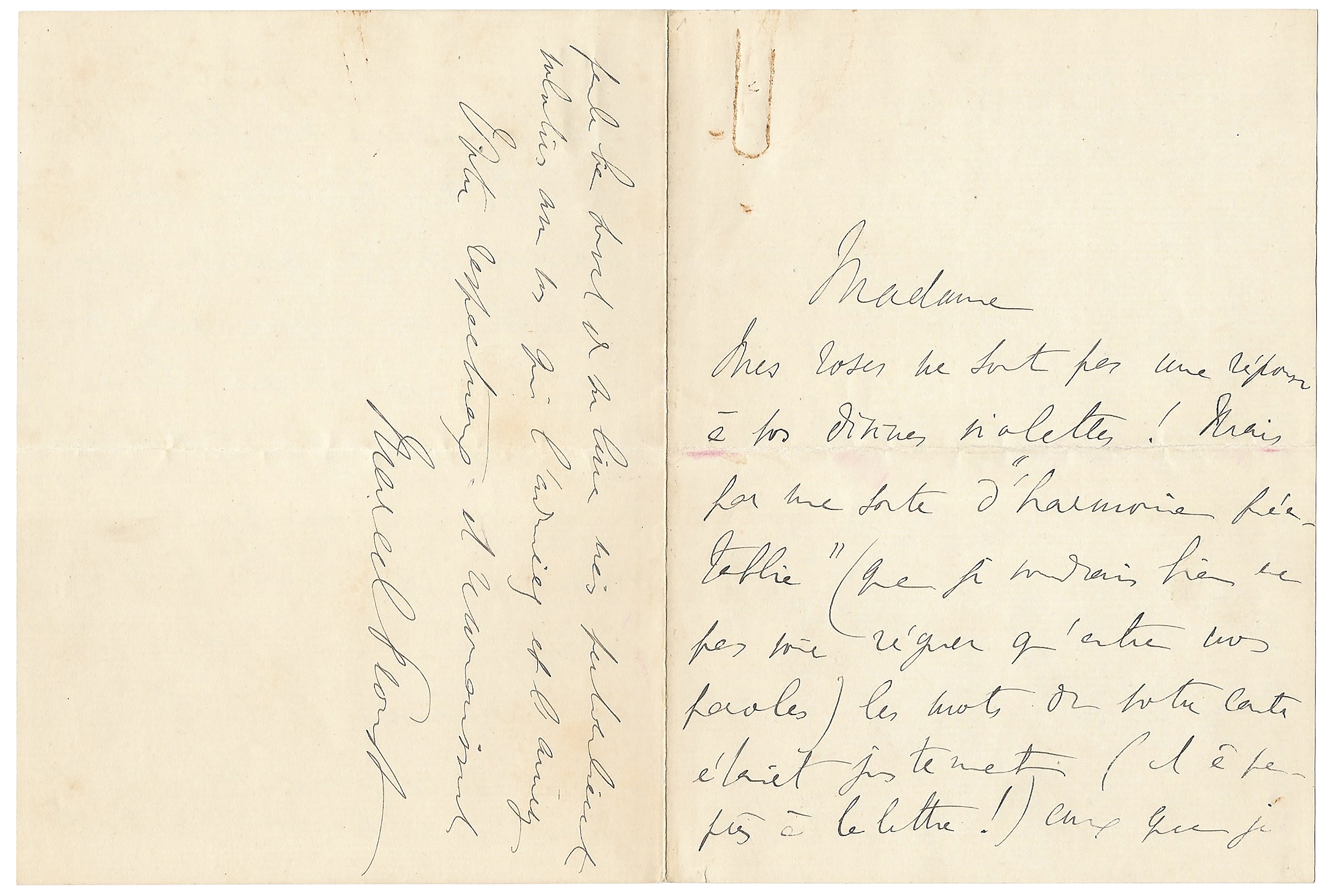
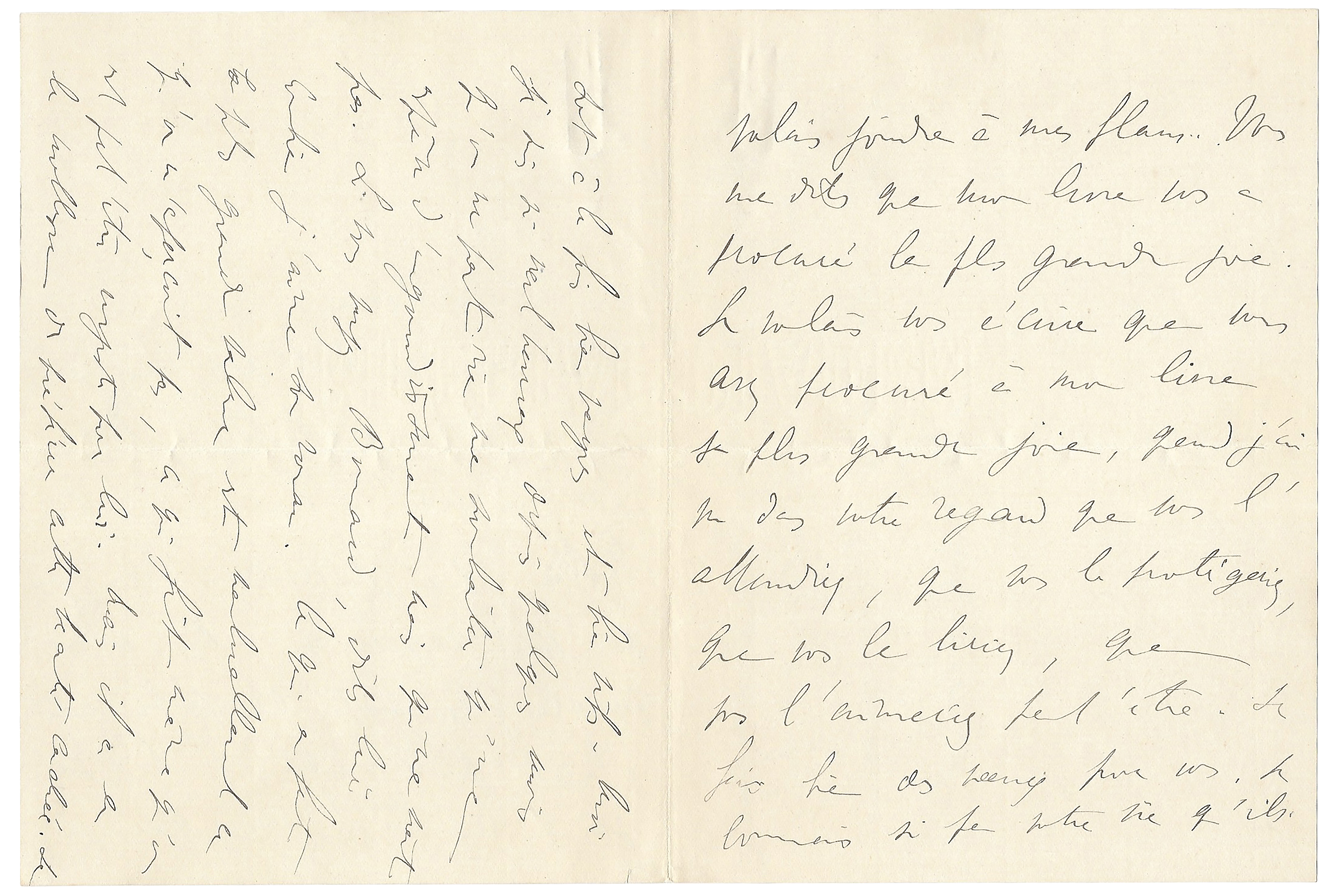
Autograph letter signed « Marcel Proust » to Marie Scheikévitch
N.p. [Paris ? c. 1er Jan. 1914], 3 p. ½ in-8° in black ink, on laid paper
Watermark: “Imperial Diadem,” adorned with a crown.
Old paper-clip mark, minimal stains.
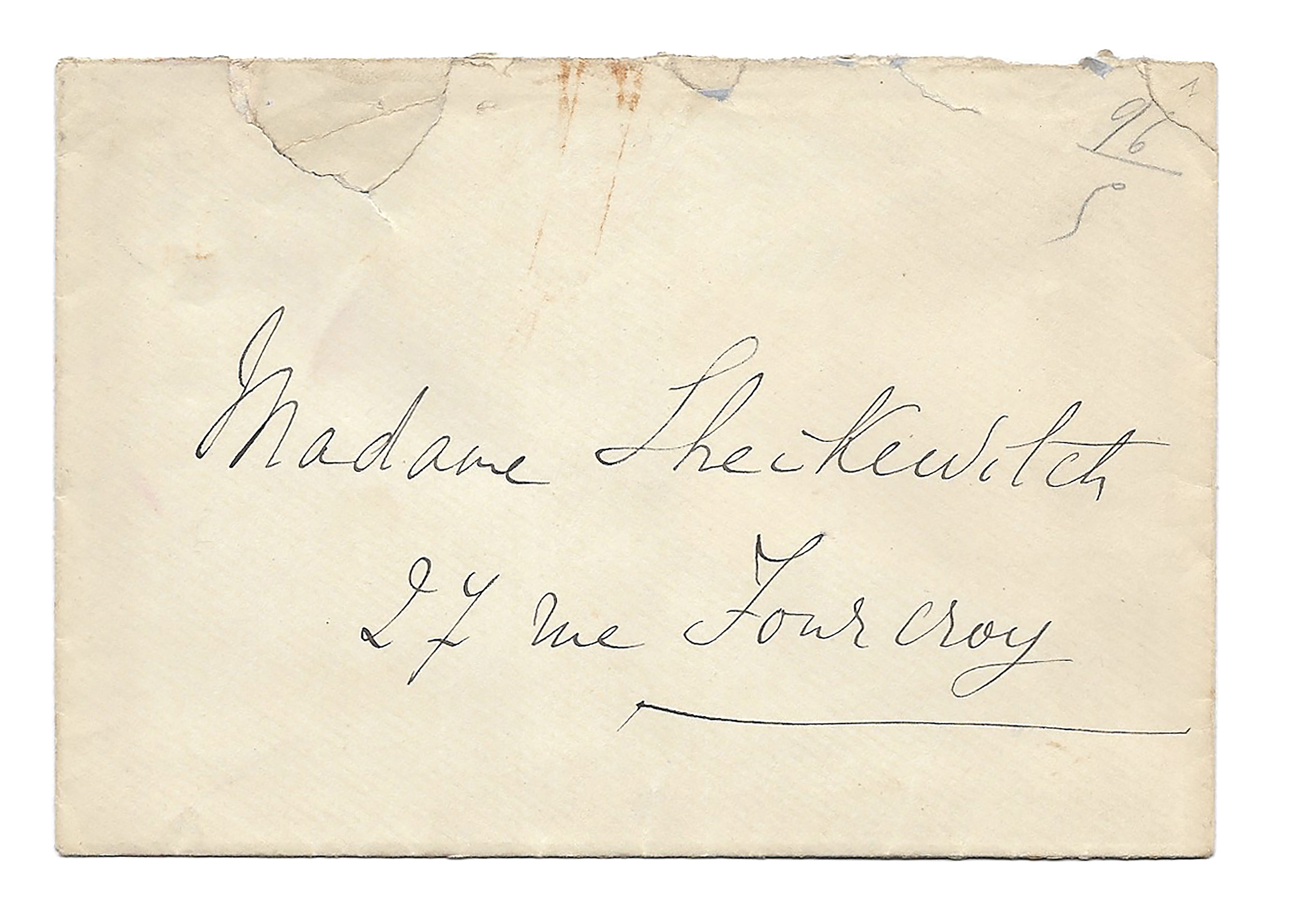
Autograph envelope enclosed (sent by hand): “Madame Scheikévitch / 27 rue Fourcroy.”
Proust is grateful to his correspondent for her laudatory reception of Swann’s way
« I wanted to write to you that you had procured for my book its greatest joy, when I saw in your gaze that you awaited it, that you would protect it, that you would read it, that you would love it, perhaps. »
« Madame,
Mes roses ne sont pas une réponse à vos divines violettes ! Mais par une sorte d’harmonie préétablie (que je voudrais bien ne pas voir régner qu’entre nos paroles), les mots de votre carte étaient justement (et à peu près à la lettre) ceux que je voulais joindre à mes fleurs. Vous me dites que mon livre [Du Côté de chez Swann] vous a procuré la plus grande joie. Je voulais vous écrire que vous avez procuré à mon livre sa plus grande joie, quand j’ai vu dans votre regard que vous l’attendiez, que vous le protégeriez, que vous le liriez, que vous l’aimeriez peut-être. Je fais bien des vœux pour vous. Je connais si peu votre vie qu’ils sont à la fois bien vagues et bien vifs. Moi je suis si malheureux depuis quelques mois qu’on ne peut rien me souhaiter qu’une espèce d’engourdissement mais qui ne vient pas. Si vous voyez Bonnard, dites-lui combien j’aime son roman [La Vie et l’Amour]. Ce qui en fait la plus grande valeur est naturellement ce qu’on aperçoit pas, ce qui fait qu’on est peut-être injuste pour lui. Mais il a eu la noblesse de préférer cette beauté cachée. Je parle bien souvent de son livre mais particulièrement volontiers avec vous qui l’admirez et l’aimez.
Votre respectueux et reconnaissant
Marcel Proust »
The first volume of À la recherche du temps perdu appeared on 14 November 1913 with Grasset, following a now-famous rejection by the NRF, whose leading figure, André Gide, later admitted that it had been “la plus grave erreur de la NRF” and one of “l’un des regrets, des remords les plus cuisants de [sa] vie.” The thank-you note sent by Marie Scheikévitch to Proust for the book, to which Proust replies in the present letter, seems to have given her time to savor its reading.
Proust here alludes to the reviews of La Vie et l’Amour, a work that Bonnard published the same year as Du Côté de chez Swann. The injustice denounced by Proust probably refers to the article by Gaston Sauvebois, published in the Nouvelle Revue Française of 1 January 1914, which he found “franchement absurde.”
Proust and Bonnard were, it seems, introduced to one another by Marie Scheikévitch. If the two writers shared common aesthetic criteria, notably a similar conception of the novel, this closeness is evident in Proust’s correspondence, which attests to a constant admiration for his friend’s Le Palais Palmacamini (1913): “Je ne peux vous dire avec quel plaisir j’ai reçu Le Palais Palmacamini. […] Je l’ai tant aimé qu’il a fait vraiment partie de ma vie, qu’il reste lié à des espérances qui se sont évanouies, à un bonheur qui est détruit.” This aesthetic affinity extends likewise to a shared judgment on contemporary literature, Proust affirming that “il me suffit de lire une ligne de vous pour penser que nous serions d’accord sur ce qu’on écrit aujourd’hui et qui est affreux.” Finally, this admiration is confirmed doubly in another letter to Marie Scheikévitch from February 1922, in which Proust simply sums up his attachment to Bonnard: “Je l’admire et je l’aime, vous le savez.”
A close friend of Proust who used her connections to help bring about the publication of the first volume of La Recherche:
Marie Scheikévitch (1882–1964) was the daughter of a wealthy Russian magistrate and art collector who settled in France in 1896. George D. Painter describes her as “une des maîtresses de maison les plus intelligentes et les plus en vue de la nouvelle génération.” A patron of artists and writers, she frequented the salons of the day before founding her own. Her circle included Jean Cocteau, Anna de Noailles, Reynaldo Hahn, and the Arman de Caillavet family — acquaintances she shared with Proust, which likely contributed to their meeting. Although they had crossed paths briefly in 1905 in the salon of Mme Lemaire, it was in 1912 that Marcel Proust and Marie Scheikévitch truly came to know one another. A correspondence followed, continuing until the writer’s death in 1922. As they saw each other “presque tous les jours,” as she would later say (friends writing to one another all the less, the more they see each other), only 28 letters from Proust to her are known to survive.
Marie Scheikévitch opened to him the doors of her salon, frequented by all that Paris counted among its illustrious figures in literature and the arts, so much so that Proust would pay her tribute in Sodome et Gomorrhe under the guise of Mme Timoléon d’Amoncourt, “petite femme charmante, d’un esprit, comme sa beauté, si ravissant, qu’un seul des deux eût réussi à plaire.”
A fervent admirer of the writer, she exerted herself considerably at the time of the publication of Du Côté de chez Swann, working hard to put Proust in contact with the Parisian figures she judged best able to help him. It was she who recommended him to her lover Adrien Hébrard, the influential director of the newspaper Le Temps, to secure for him the famous interview of 12 November 1913 by Élie-Joseph Bois, on the eve of the publication of Swann. This would be the first major article published in the mainstream press devoted to La Recherche. To thank her for this, Proust sent her a major autograph inscription (acquired by the BnF in 2021) upon the publication of Swann.
Provenance:
Cat. Andrieux, 12 March 1928; n°190 ; then private coll.
Bibliography:
Lettres à Madame Scheikévitch, Librairie des Champs-Élysées, 1928, p. 45-46 ; Corr., t. XIII, Kolb, Plon, 1985, n°1 ; Marcel Proust II – Biographie, Jean-Yves Tadié, Folio, pp. 391-392
Join our mailing list and be the first to hear our latest news and biggest announcements.
By signing up you agree to our privacy policy. You can unsubscribe at any time.