Keep ahead of the pack
Join our mailing list and be the first to hear our latest news and biggest announcements.
By signing up you agree to our privacy policy. You can unsubscribe at any time.
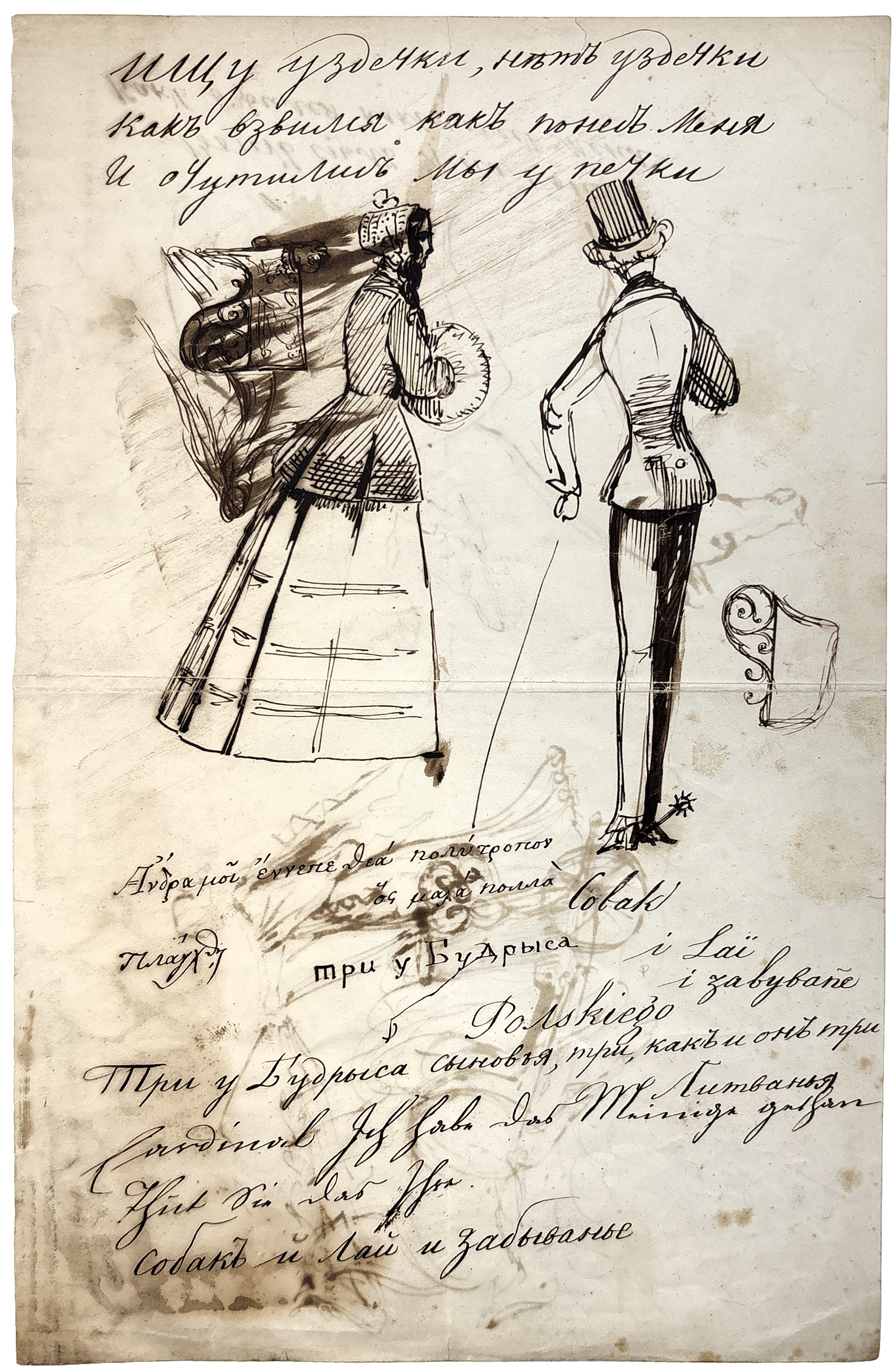
Autograph notes and original drawings
N.p.n.d. [c. 1850 ?] 2 p. in-folio
« собак и лай и завыванье »
Autograph notes and original drawings
N.p.n.d. [c. 1850 ?] 2 p. in-folio
Central fold; small holes from corrosion caused by the iron gall ink used by Mérimée
Verses by Pushkin and original drawings: a spectacular unpublished autograph leaf by Mérimée
These original notes and drawings form a composite ensemble by the writer, as was his habit. While many such leaves have come down to us, this one has remained unknown to scholars.
Mérimée’s unwavering admiration for Pushkin is well known. Besides the many translations he made of the Russian poet’s verse, the most famous of all remains The Queen of Spades, a short story first published in Russia in 1834.
At the foot of the leaf, the writer-translator has carefully copied out, in Cyrillic script, two extracts from poems by Pushkin, which he also translated:
The first is the incipit of Boudrys and His Sons (Будрыс и его сыновья, 1833), adapted by the Russian poet from Mickiewicz’s Polish poem Trzech Budrysów: « Boudrys has three sons, three Lithuanians, like himself ». The line introduces old Boudrys and his three sons, whom he sends each in a different direction (Russia, Germany, Poland) to seek their fortune.
Further down the leaf, Mérimée has copied out an isolated line that seems to belong to the poem The Gypsies (Цыганы, 1824), with an error: « Собак и лай и забыванье », literally « Of dogs the barking, and oblivion », whereas the correct line is Собак и лай и завыванье. This is the famous passage of the poem describing the Gypsy camp on the move: Лохмотьев ярких пестрота, Детей и старцев нагота, Собак и лай и завыванье, Волынки говор, скрып телег (« The motley of bright rags, the nakedness of children and old men, the barking and howling of dogs, the drone of the bagpipe, the creaking of carts »). Mérimée’s translation is not literal: « What a motley of brightly colored rags! The dogs howl at the bagpipe droning on, while the wheels creak on the gravel. »
At the very top of the leaf appears the poem The Hussar (1833), again in Cyrillic script: Ищу уздечки, нет уздечки / Как взвился, как понёс меня / И очутились мы у печки (Mérimée’s translation, once again not literal: « I look for the reins, no reins. He bolts, he carries me off. What a pace! And I find myself in front of our stove »). The same line is found written on the verso of the leaf.
In the center of the leaf, Mérimée has copied out in Greek script the incipit of the Odyssey: Ἄνδρα μοιἔννεπε, Μοῦσα, πολύτροπον, ὃς / μάλα πολλὰ πλάγχθη, with a single inaccuracy: in place of « Μοῦσα » (Muse), Mérimée writes « Δεά » (Goddess).
The first page is illustrated with a fine, fairly accomplished drawing depicting two figures in clothing styles contemporary with Mérimée. A woman is shown in profile, her hands tucked into a muff, while to the right stands a man seen from behind, wearing a top hat and a fitted jacket. A spur can be seen protruding from his right foot, perhaps a nod to the poem The Hussar? Two geometric figures frame the couple on either side.
Two other large drawings appear on the verso of the leaf: the first shows a woman dressed in the Greek style, in a chariot, whipping four horses.
The second drawing shows a woman, whip in hand, on horseback.
Boudrys and His Sons: Pushkin translated this poem by Mickiewicz in 1833 and published it the following year in the Cabinet de lecture under the subtitle « Lithuanian ballad, inspired by M. »; this mention would disappear from later editions (1835, 1838). Mérimée in turn made a translation of it, which remained unpublished in his lifetime and is held at the BnF (Naf -22739), without knowing at the time that it was an adaptation of Mickiewicz rather than an original work by Pushkin.
The Hussar: Mérimée seems to have included the translation of the poem in his collection of Nouvelles (Paris, Michel Lévy frères, 1852) simply « to fill out the volume », if his letter to Sobolevsky is to be believed. This ballad corresponds to Mérimée’s idea of the fantastic, as shown by his article on Pushkin (Œuvres complètes, Section I: Literature, vol. 6: Studies and Translations of Russian Literature, ed. Antonia Fonyi, p. 89), in which he praises the poet’s style in his tales of the marvelous and his ability to adopt, like popular storytellers, a contagious childlike credulity. The Gypsies: like The Hussar, Mérimée asks for this poem to be included to pad out the volume (see above). One may note a kinship between Zemfira, the heroine of The Gypsies, and Carmen, both claiming freedom in love.
Provenance:
Private collection
Bibliography:
Œuvres complètes, Section I : Littérature, tome 6 : Études et traductions de littérature russe, dir. Antonia Fonyi, textes établis, présentés par Jean-Louis Backès, annotés par Jean-Louis Backès et Antonia Fonyi avec le concours de Michel Cadot, Paris, Honoré Champion, 2016, p. 281, 315.
Join our mailing list and be the first to hear our latest news and biggest announcements.
By signing up you agree to our privacy policy. You can unsubscribe at any time.