Keep ahead of the pack
Join our mailing list and be the first to hear our latest news and biggest announcements.
By signing up you agree to our privacy policy. You can unsubscribe at any time.
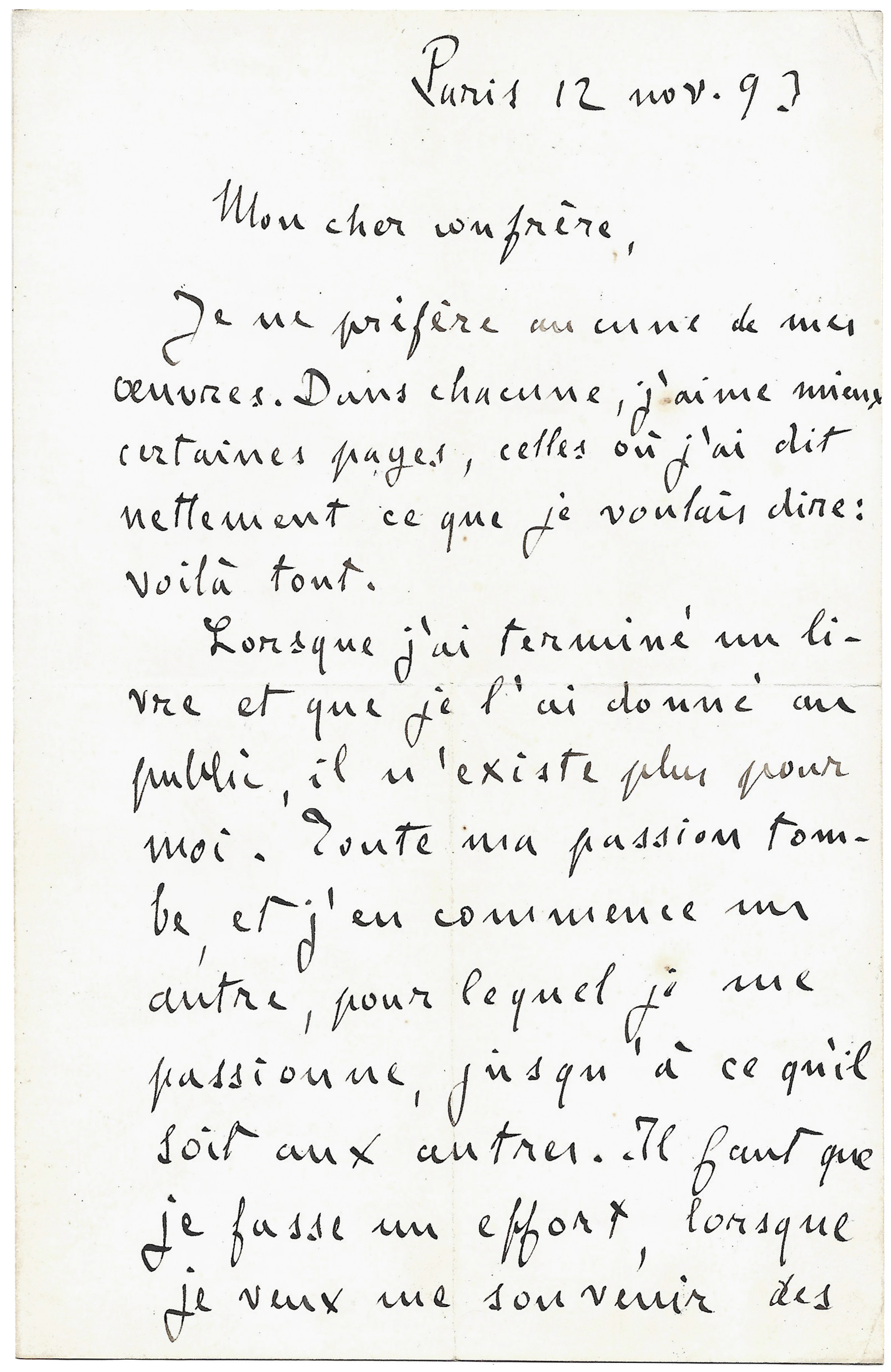
Autograph letter signed « Emile Zola » to a colleague
Paris, 12th November [18]93, 1 p. 1/2 in-8°
“When I have finished a book and given it to the public, it no longer exists for me. All my passion collapses”
Autograph letter signed « Emile Zola » to a colleague
Paris, 12th November [18]93, 1 p. 1/2 in-8°
Usual fold marks, some tiny spots
Magnificent Letter Written at the Conclusion of the Rougon-Macquart Saga
ZOLA’S BYGONE PASSIONS
« Mon cher confrère,
Je ne préfère aucune de mes œuvres. Dans chacune, j’aime mieux certaines pages, celles où j’ai dit nettement ce que je voulais dire : voilà tout.
Lorsque j’ai terminé un livre et que je l’ai donné au public, il n’existe plus pour moi. Toute ma passion tombe, et j’en commence un autre, pour lequel je me passionne, jusqu’à ce qu’il soit aux autres. Il faut que je fasse un effort, lorsque je veux me souvenir des romans, hélas ! trop nombreux que j’ai écrits. Ce sont comme des tombes de parents et d’amis, autrefois bien chers, sur lesquelles il me serait trop triste d’aller m’attendrir.
Cordialement à vous.
Emile Zola »
The Rougon-Macquart saga comes to an end with the publication, by Charpentier, of Le Docteur Pascal in the spring of 1893. Already very popular at the time of their release, most of the novels in the cycle soon entered the realm of legend. Among the most famous are Germinal, Nana, and L’Assommoir. In total, twenty novels were written and published between 1870 and 1893. Zola is here most likely responding to a fellow journalist wishing to write an article on the entire saga and on what it represents in the eyes of the novelist.
A summary of the letter and the quotation of a single sentence were published in volume VIII of the correspondence, based on an excerpt from a catalogue:
“This is like the graves of parents and friends […]”. This comparison aptly conveys the sadness that emanates from this moving statement and what Zola’s works represent to Zola himself. Whether understood as a personification of the books or as a metonymy designating the characters to whom the author gave life, the “graves” naturally refer to death. And if, when one loses a parent or a friend, one loses a part of oneself, then what does it mean to lose the parents and friends of twenty novels?
Provenance:
Extr., cat. libr. Charavay, n° 6599
Bibliography:
Correspondance, t. VIII, éd. du CNRS, Les Presses de l’université de Montréal, p. 82 – 83, n°28 (partly transcribed)
Join our mailing list and be the first to hear our latest news and biggest announcements.
By signing up you agree to our privacy policy. You can unsubscribe at any time.